
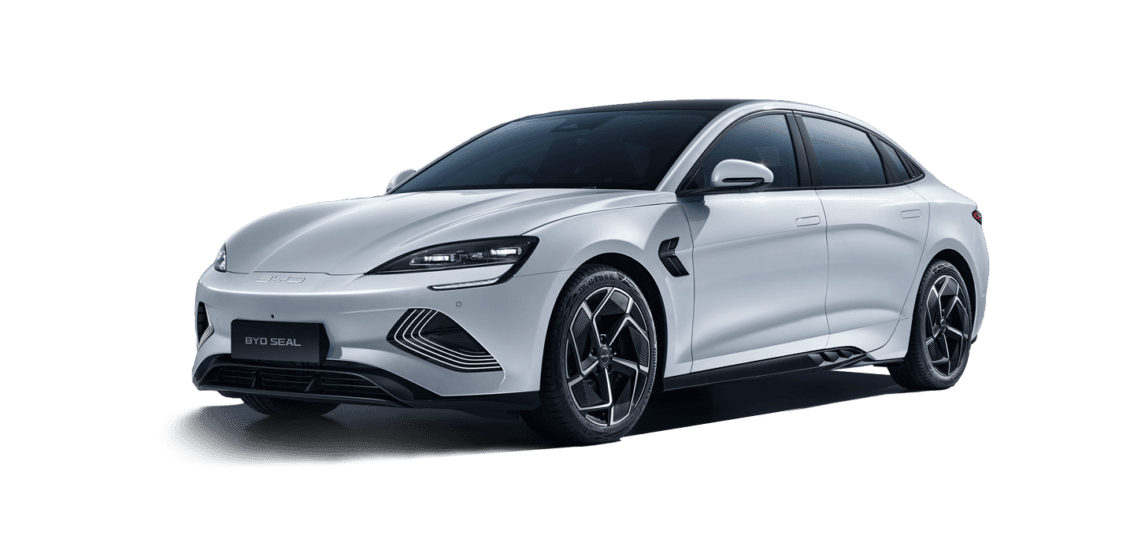

BYD Seal
2024 Sedan · ฿1,325,000 – ฿1,599,000 · 7.8/10 avg from 1 review

CarsGuide
303K subscribers·2 years ago· EN
BYD Seal 2024 Review: Premium - A Serious Tesla Model 3 Challenger
Tesla Model 3 beater? BYD Seal 2024 review: Premium | Is this new electric car the best EV sedan?
I came in skeptical about the Seal and left genuinely impressed—this isn't just a cheap Chinese knockoff, it's a proper sedan that drives better than I expected with a comfortable back seat and composed ride quality. It wears some borrowed design language a bit too openly and the software is just an Android reskin, but what really matters is that it delivers a compelling package for what you're getting.
First Impressions
I'll be honest: I underestimated the Seal before I drove it. The other BYDs I'd sampled—the Atto 3 and Dolphin—were good, but they didn't feel like a meaningful step beyond mainstream automakers. This car is different. From the moment I settled into the cabin, it was clear that BYD had something to prove, and they proved it. The Seal presents itself as a proper sedan, not a budget hack, and it backs up that promise in ways that genuinely surprised me.
Design and Exterior
The Seal wears a modern sedan silhouette that's low, curvy, and deliberately sporty—a sharp contrast to the minimalism of the Model 3. The design doesn't scream 'cut-price Chinese car' at all. Those side lines are particularly well-executed, and the boot lid and tail lights feel carefully considered rather than off-the-shelf borrowing. It's maximalist compared to Tesla, sure, but that's refreshing in a segment that's increasingly sterile.
However, the moment you step inside, you'll notice the cabin isn't entirely original. That digital dash screams Mercedes influence, the crystal-style shifter nods to Volvo, and the dual charging pads and screen layout owe an obvious debt to Tesla. These aren't deal-breakers—they're just noticeable. What matters more is that the leather-and-synthetic blend on the seats and trim feels genuinely nice, and those little seal flipper-shaped speaker grilles and door handles show that BYD sweats the details where it counts.
Interior and Technology
The Seal's cabin is genuinely impressive at first glance. The seats are plush with intricate stitching, and soft-touch materials wrap almost everything your arms and knees touch. You get dual wireless phone chargers, a massive 15.6-inch touchscreen with both wireless Android Auto and wired Apple CarPlay, dual-zone climate control, 8-way power seat adjustment, and ventilated front seats—all standard on this mid-spec Premium variant.
There's a rotating screen feature if you want it, though Apple CarPlay doesn't work when rotated, which seems like an oversight. Storage is generous: deep door bins, a massive pass-through under the bridge console, and a foldout cup holder with two different sizes. The real revelation is the back seat. The legroom is enormous—more than I get in most large SUVs—and because the seats recline generously, you slide back into them, creating even more space. The panoramic roof has a heavy tint and foldout cover to manage heat in Australian summers.
The software is where things stumble. Yes, it's responsive and looks polished initially, but dig into a few menus and it's painfully obvious this is just an Android reskin. Better than many Chinese competitors, sure, but you expect more when the touchscreen is this central to the experience. That said, wireless charging, the storage philosophy, and the attention to passenger comfort partly make up for the software's limitations.
Driving Experience
This is where the Seal truly earns its place. The steering is tight and engaging—a touch artificial, but so are most segment rivals, including the Model 3. What impressed me most was the grip. Those Continental tyres on a wide, long-wheelbase platform make aggressive cornering feel planted and controlled, which was a real weakness on BYD's earlier models.
The ride is the standout. While the Polestar 2 and Model 3 are known for their firmness, the Seal strikes a better balance—soft enough to soak up bumps without the floaty disconnected feel, yet sprung tightly enough to control battery weight. It reminds me of the Mustang Mach-E's suspension tuning. Yes, there's a bit of secondary jiggle over big hits and some busyness in the cabin, but for a low-slung sedan with battery pack underneath, this is genuinely impressive. Power delivery feels slightly duller than the competition in regular mode, but engage Sport mode and the linear acceleration becomes convincing in the real world. Combined with excellent sound deadening, this is a refined, quiet cabin—exactly the kind of car you want to live with daily.
Active safety features are well-calibrated, with a lane-keep system that doesn't interfere, though the overspeed warning sometimes picks the wrong limit and nags relentlessly. The adaptive cruise control isn't quite as smooth as Tesla's implementation, feeling more like a conventional system than something cutting-edge.
Practicality
The boot sits at 400 litres, which sounds decent until you realise a full luggage set won't fit in one go. That's one of the sedan trade-offs. There's a 50-litre frunk to make up some ground, and beneath the boot floor is a useful charging cable storage area, though you'll only find a repair kit—no spare wheel.
On the charging front, the 150 kW DC fast-charging tops up 10-80% in 37 minutes, which is respectable. AC charging is the letdown at just 7 kW—hardly worth plugging into a public slow charger when you're shopping, as you'll only gain about 50 km per hour. Most cars with this size battery offer 11 kW AC charging, so this is a clear miss. The Seal does come with V2L capability, letting you power household appliances from the charging port, which is a nice practical touch. Real-world consumption aligned with the claimed 14.6 kWh per 100 km, and the 510 km WLTP range puts it ahead of the base Model 3.
The Verdict
The BYD Seal is another impressive offering from China's most formidable EV maker, and there's a reason auto executives are losing sleep. It's not perfect—it tries too hard to ape luxury brands in places, and the software needs refinement—but it does so much right that it's hard to find real fault. The ride quality, rear-seat comfort, standard equipment, and overall driving manners make it a genuine contender that should worry the established players. If you're cross-shopping sedans in this space, the Seal deserves serious consideration.
Pros
- Exceptional rear legroom and comfort, even for adults in the middle seat
- Best ride quality of its direct competitors, firm yet well-damped
- Tight, engaging steering with strong cornering grip
- Quiet and refined cabin with quality sound deadening throughout
- Massive 15.6-inch touchscreen with wireless Android Auto and Apple CarPlay
- Plush leather-trimmed interior with soft-touch materials nearly everywhere
- Dual wireless phone chargers and dual-zone climate control as standard
- 510 km WLTP range on the mid-spec model
Cons
- Software is clearly just an Android reskin, lacks refinement despite looking slick
- Apple CarPlay doesn't work properly when screen rotates
- AC charging maxes out at 7 kW, making public slow chargers nearly useless
- 360-degree camera only in top variant, not on mid-spec
- Boot space limited at 400 litres, luggage set won't fit flat
- No spare wheel, only a repair kit underneath floor panel
- Acceleration response slightly dull compared to Model 3 and Polestar 2
- Lane-keeping assist and adaptive cruise not as polished as Tesla's system
Verdict
“The BYD Seal is a genuine contender that finally shows why executives are worried about Chinese EVs—it's not pretending to be a luxury car, it's just offering real comfort and capability at a compelling point. Buy it if you want a practical sedan that prioritizes passenger comfort and real-world driving manners over cutting-edge tech gimmicks.”